
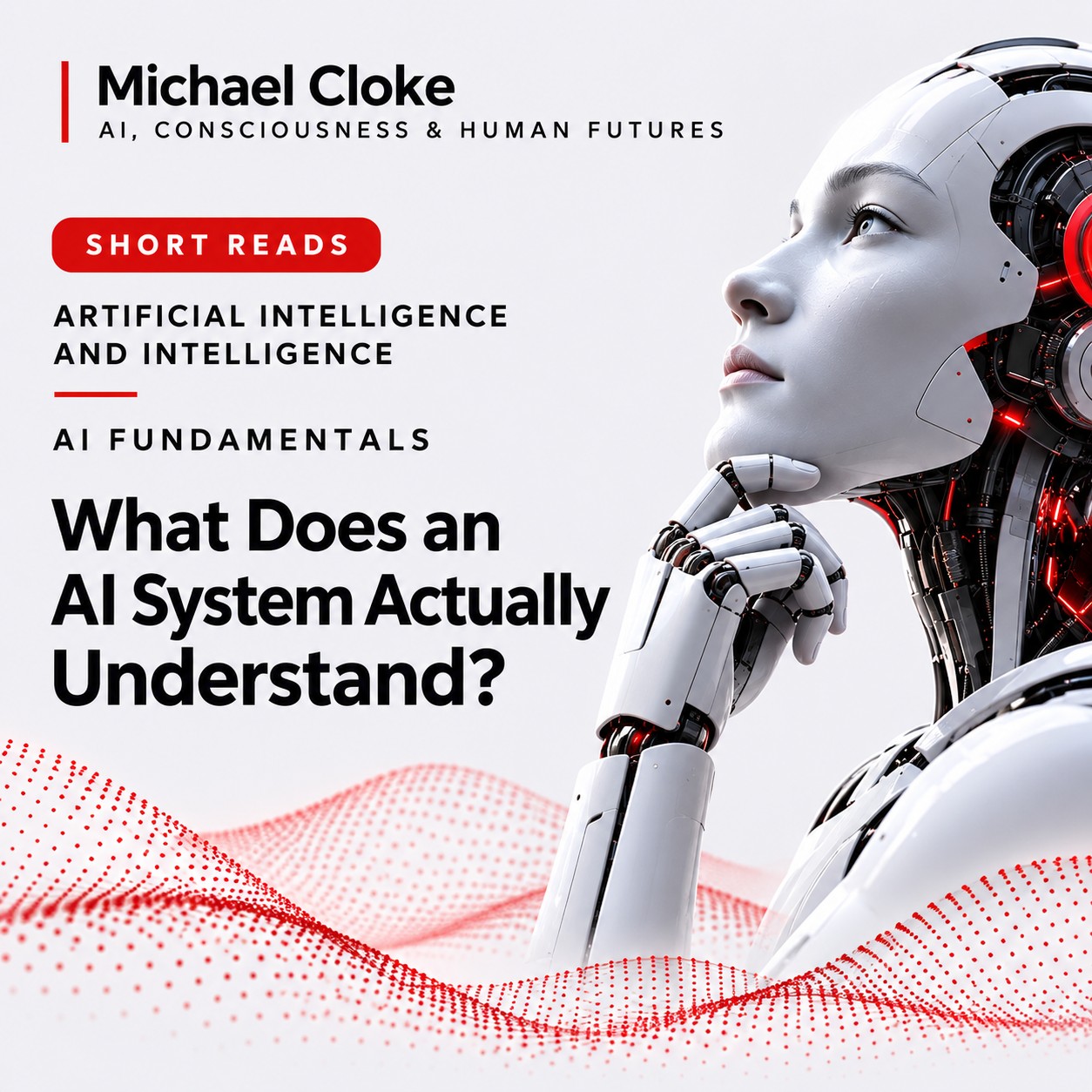
What Does an AI System Actually Understand?
Modern artificial intelligence can explain complex ideas, solve problems and engage in remarkably sophisticated conversations. But does this demonstrate genuine understanding, or are we confusing the ability to produce meaningful answers with the capacity to understand their meaning?
Artificial intelligence has reached a point where its capabilities challenge some of our assumptions about intelligence itself.
Large language models can interpret questions, explain scientific concepts, write computer programmes and construct arguments that appear remarkably similar to human reasoning. In some specialised tasks, they can even outperform highly trained professionals.
Yet beneath these achievements lies a fundamental question: what, if anything, does an AI system actually understand?
How Modern AI Systems Process Information
Most contemporary language models are built using neural networks trained on enormous quantities of data.
During training, these systems learn statistical and structural relationships between words, concepts and patterns of information. Through this process, they develop internal representations that enable them to generate responses, make predictions and perform increasingly complex tasks.
Importantly, this is not simply a matter of retrieving memorised sentences.
Modern AI systems can combine information in novel ways, apply learned relationships to unfamiliar problems and produce outputs that were never explicitly included in their training data.
Nevertheless, their underlying mechanisms differ substantially from those of human cognition.
The Difference Between Performance and Understanding
Consider a simple example.
An AI system can explain why a glass falls when released, describe gravitational acceleration and calculate the time required for the glass to reach the ground.
Does this mean it understands gravity?
The answer depends largely on what we mean by understanding.
If understanding means possessing an internal model that supports explanation, prediction and successful problem-solving, then certain AI capabilities may reasonably qualify as forms of understanding.
However, if understanding requires conscious awareness, lived experience or an appreciation of meaning comparable to human comprehension, the question becomes considerably more difficult.
There is no universally accepted scientific definition of understanding that resolves this distinction.
Can Understanding Exist Without Experience?
Human understanding is closely connected to our physical existence.
We encounter the world through perception, movement, memory, emotion and interaction with our surroundings. Our concepts develop partly through experiences of physical and social reality.
AI systems develop their capabilities through different processes.
A language model may possess extensive information about pain without ever having experienced pain. It may explain the sensation of warmth without having felt sunlight.
But does the absence of human-like experience necessarily prevent understanding?
Some theories of cognition suggest that understanding depends primarily on the functional organisation of information processing. Others emphasise embodiment, biological processes or conscious experience.
These competing perspectives remain subjects of scientific and philosophical investigation.
What We Can Reasonably Conclude
There is substantial evidence that modern AI systems acquire useful internal representations and can perform tasks requiring sophisticated information processing.
What remains disputed is whether these abilities constitute understanding in the same sense that humans understand the world.
We should therefore avoid two premature conclusions: that AI systems genuinely understand everything they can explain, and that their abilities amount to nothing more than meaningless imitation.
Neither position adequately captures the complexity of the evidence.
Perhaps the most important question is not simply whether artificial intelligence understands, but whether our existing concept of understanding is sufficiently precise to evaluate intelligence that develops outside human biology.
That question may become increasingly significant as artificial intelligence advances.
Michael Cloke | Independent Research · Critical Inquiry · Perspectives
AI, Consciousness & Human Futures
