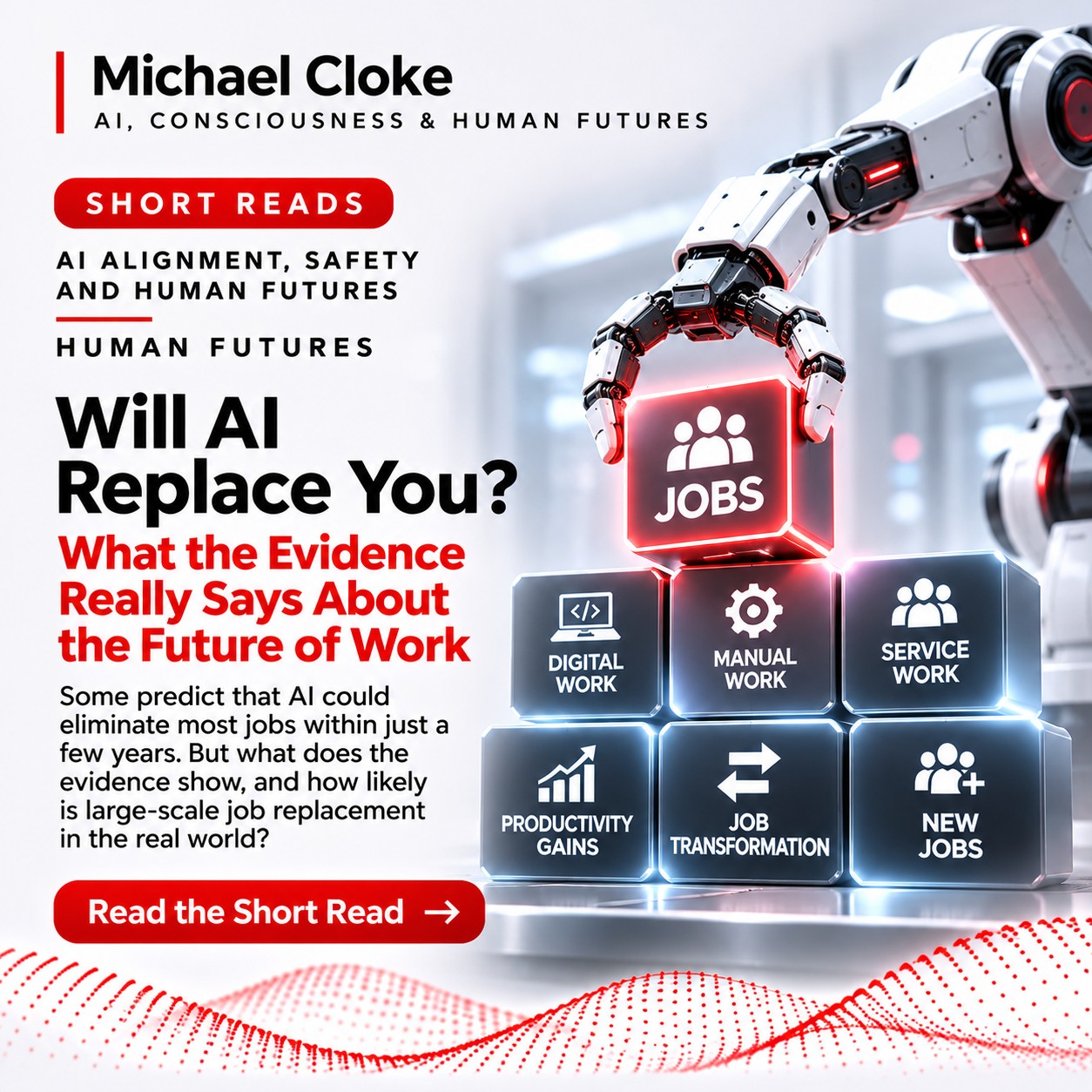
Will AI Replace You? What the Evidence Really Says About the Future of Work
Artificial intelligence is transforming professional work, while humanoid robots promise to automate physical labour. Some commentators predict that most jobs could disappear within just a few years. But how much of this is supported by evidence, and how much remains speculation?
Imagine an accountant who spends much of their working day preparing financial reports.
An advanced AI system can now analyse transactions, identify discrepancies, prepare summaries and generate reports in a fraction of the time previously required.
Does this mean the accountant is about to lose their job?
Possibly. But not necessarily.
The accountant may still need to interpret the findings, exercise professional judgement, advise clients and accept responsibility for decisions.
Alternatively, an employer might decide that fewer accountants are needed because AI allows the remaining staff to accomplish considerably more.
Both outcomes are possible.
This illustrates a distinction that is often overlooked in discussions about artificial intelligence and employment.
The ability to automate individual tasks is not the same as the elimination of an entire occupation.
Is AI Already Replacing Human Workers?
Artificial intelligence is increasingly capable of performing activities previously undertaken by human workers.
Writing, programming, document analysis, customer support and administrative processing are among the areas experiencing significant technological change.
Some organisations are already restructuring work around these capabilities.
However, the wider employment picture remains complicated.
Research from the International Labour Organization suggests that approximately one-quarter of jobs worldwide are potentially exposed to generative AI, with job transformation generally considered more likely than complete replacement.
Exposure does not mean that every affected worker will lose their employment.
It means that AI could change the tasks, skills and responsibilities associated with their occupation.
Nevertheless, even partial automation can have serious consequences.
If a company can produce the same output with fewer employees, some positions may disappear. New entrants to the labour market may also encounter fewer opportunities to acquire experience.
The effects will depend upon the occupation, the organisation and the wider economy.
Could AI Really Replace 90% of Jobs Within Two Years?
Some commentators have suggested that artificial intelligence could eliminate the overwhelming majority of human employment within just a few years.
Such predictions deserve scrutiny.
For 90% of jobs to disappear by late 2028, AI would need not only to demonstrate extraordinary capabilities but also to be adopted across almost every major industry at unprecedented speed.
Businesses would need to integrate new systems, reorganise operations, establish reliable oversight and address legal, financial and practical constraints.
Many occupations also involve physical interaction, interpersonal relationships, unpredictable environments and responsibilities that cannot easily be reduced to digital tasks.
This does not make large-scale automation impossible.
It does, however, mean that predictions of near-total employment replacement within two years are not supported by the available labour-market evidence.
We should distinguish what technology might eventually achieve from what economies are likely to implement within a particular timeframe.
What About Humanoid Robots?
Elon Musk and other technology leaders have predicted that increasingly capable humanoid robots will eventually undertake substantial amounts of physical labour.
Tesla’s Optimus project is one example of efforts to develop general-purpose robots capable of working in environments designed for humans.
The ambition is significant.
A humanoid robot might eventually perform warehouse operations, manufacturing tasks, cleaning, maintenance or domestic assistance.
But consider a seemingly simple activity: clearing a table after a meal.
A human worker can recognise fragile objects, distinguish rubbish from valuable possessions, handle unexpected obstacles and adapt immediately when something goes wrong.
A robot must integrate perception, movement, manipulation and decision-making to perform the same activity safely and reliably.
A successful demonstration is an engineering achievement.
It is not necessarily evidence that the system can replace a human worker across an entire shift, at an acceptable cost, without extensive supervision.
Robotic capability and economically viable labour replacement are two different milestones.
Will AI Create New Jobs?
Technological change has historically eliminated some occupations while creating others.
Mechanisation transformed agriculture. Industrial automation changed manufacturing. Computers displaced certain clerical activities while generating new industries and professions.
Artificial intelligence may produce similar patterns.
New occupations could emerge in AI oversight, robotics maintenance, system evaluation and fields that do not yet exist.
However, history does not guarantee that displaced workers will find equally rewarding employment.
AI may also differ from earlier technologies because it can automate aspects of cognitive work across many industries simultaneously.
The speed of change, the availability of retraining and the distribution of economic benefits will therefore matter considerably.
What If Machines Eventually Perform Most Work?
There is a deeper question beyond employment statistics.
Suppose artificial intelligence and robotics eventually become capable of performing most economically valuable human activities.
Such a development could produce extraordinary material abundance.
Goods and services might become cheaper. Scientific progress could accelerate. People might gain greater freedom to pursue education, relationships, creativity and other meaningful activities.
But none of these benefits would be automatic.
If productive technologies are controlled by a relatively small number of organisations, the resulting wealth might become increasingly concentrated.
People could lose employment income without receiving a corresponding share of the economic benefits.
A society in which machines perform most work is not necessarily a society in which everyone can afford to stop working.
The future of employment is therefore also a question about ownership, economic distribution, education and the social institutions through which people participate in society.
What Can We Reasonably Conclude?
Artificial intelligence is already changing the nature of work, and some occupations will undoubtedly face substantial disruption.
Yet the claim that almost all human jobs will disappear within two years goes far beyond what current evidence establishes.
The more credible concern is not that every occupation will suddenly vanish, but that technological change may proceed faster than workers, businesses and institutions can adapt.
Some people may benefit enormously. Others may experience significant economic insecurity.
The outcome will depend not only upon what artificial intelligence becomes capable of doing, but also upon the choices societies make about its development and deployment.
Perhaps the most important question is not whether artificial intelligence will eventually become capable of performing our jobs, but whether humanity can organise the benefits of that capability in ways that improve human lives rather than simply displacing human livelihoods.
The future of work is not determined by technological capability alone.
It will also be shaped by human decisions.
Michael Cloke | Independent Research · Critical Inquiry · Perspectives
AI, Consciousness & Human Futures
Further Reading
1. Gmyrek, P. et al. (2025). Generative AI and Jobs: A Refined Global Index of Occupational Exposure. International Labour Organization, Working Paper 140. Examines occupational exposure to generative AI, distinguishing potential task automation from employment displacement.
2. OECD (2026). OECD Employment Outlook 2026: Geographic Disparities in Jobs and Incomes. Reviews labour-market developments, including emerging evidence of AI’s effects on employment and the particular challenges facing younger workers.
3. Tesla (2026). Q2 2026 Update. Provides primary-source information about Tesla’s Optimus development and production infrastructure. This should be read as company reporting, not independent validation of commercial readiness.