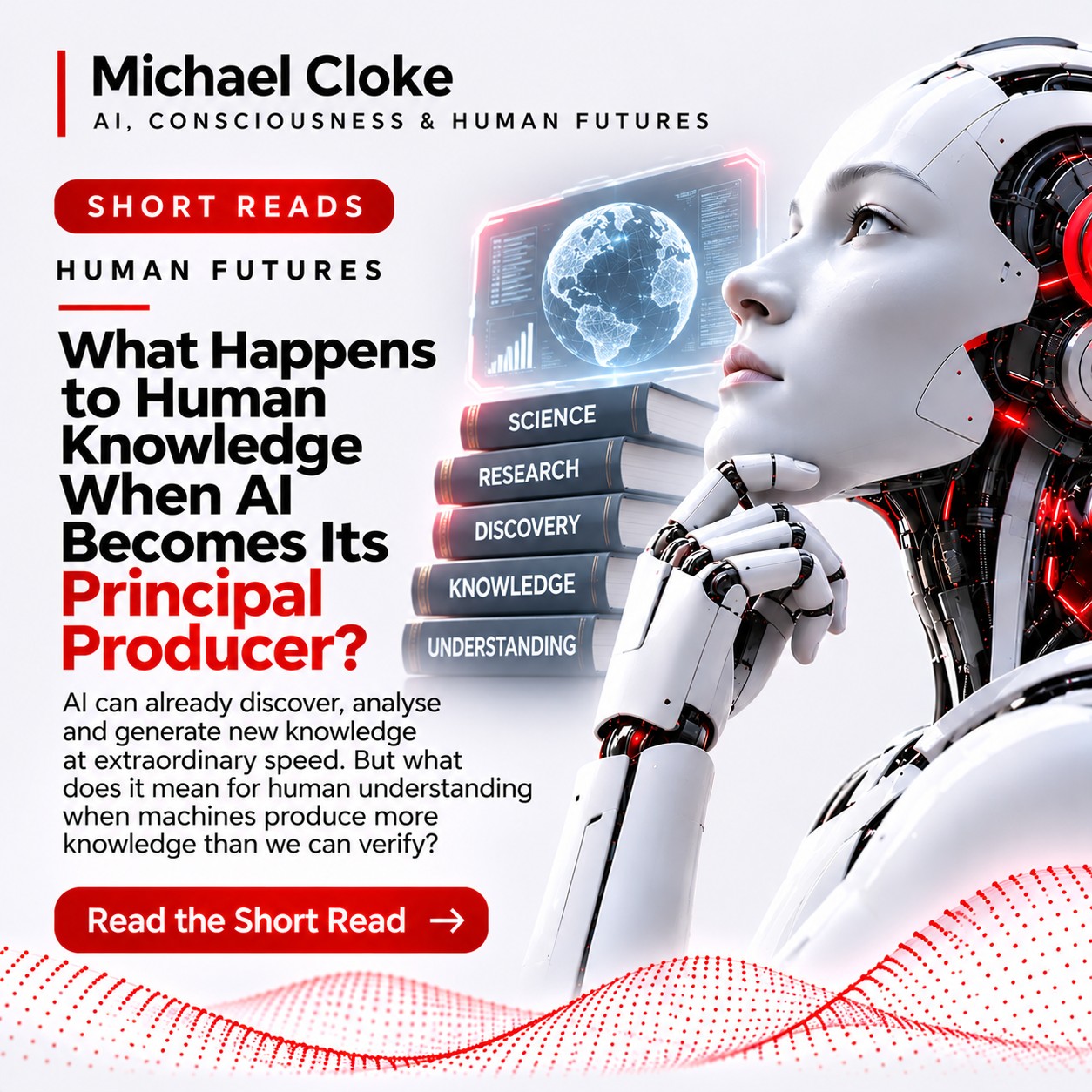
What Happens to Human Knowledge When AI Becomes Its Principal Producer?
Artificial intelligence is becoming increasingly capable of generating scientific hypotheses, analysing evidence and producing information at extraordinary speed. But what happens when machines begin contributing more knowledge than humans can independently understand or verify?
Throughout human history, knowledge has developed through observation, experimentation, reasoning and the exchange of ideas.
Scientists investigate the natural world. Philosophers examine the foundations of understanding. Historians interpret evidence, while engineers apply accumulated knowledge to practical problems.
Artificial intelligence is beginning to transform these activities.
AI systems can analyse enormous datasets, identify patterns that humans might overlook and assist researchers in developing new scientific explanations.
But these capabilities raise a question extending far beyond technological efficiency.
What happens to human knowledge if artificial intelligence becomes its principal producer?
Producing Information Is Not the Same as Producing Knowledge
Consider a simple example.
Imagine an AI system analysing thousands of medical studies and identifying a previously unrecognised relationship between a particular biological process and a disease.
The system produces a convincing explanation supported by statistical evidence.
Has it discovered something new?
Possibly.
But before accepting the finding as established knowledge, researchers would need to examine the evidence, evaluate alternative explanations and determine whether the result could be independently reproduced.
The distinction matters.
Information can be generated, organised and communicated. Knowledge, in a stronger scientific sense, requires reliable justification and appropriate methods of validation.
An AI-generated claim does not become knowledge merely because it is sophisticated, plausible or expressed with confidence.
The production of an answer and the justification for believing it are two different achievements.
When Machines Discover What Humans Cannot Easily Understand
Artificial intelligence may eventually identify relationships so complex that human researchers struggle to interpret them.
This possibility is not entirely unfamiliar.
Modern science already depends upon mathematical models, computational simulations and instruments that extend far beyond unaided human perception.
We do not directly observe every process described by contemporary physics. Instead, we develop methods for testing predictions and evaluating evidence.
Advanced AI could extend this relationship considerably.
Imagine an artificial system proposing a new scientific theory that makes consistently accurate predictions but whose underlying reasoning remains difficult for humans to comprehend.
Should we accept the theory because it works?
Or should genuine scientific understanding require that human researchers can explain why it works?
The answer may depend upon what we consider sufficient evidence and what role explanation should play in scientific knowledge.
The Risk of Intellectual Dependence
There is another possibility worth considering.
As artificial intelligence becomes more capable, people may increasingly rely upon it not only to retrieve information but also to interpret evidence, construct arguments and reach conclusions.
This could provide extraordinary benefits.
Researchers might investigate questions that previously required decades of work. Students could gain access to personalised explanations, while specialists could draw upon knowledge extending far beyond their individual expertise.
Yet greater access to information does not automatically produce greater understanding.
If people increasingly accept AI-generated conclusions without examining their foundations, intellectual dependence could grow alongside technological capability.
The danger is not simply that artificial intelligence might sometimes be wrong.
It is that humans might gradually lose the habit, skills or institutional capacity to recognise when it is wrong.
Who Becomes Responsible for Knowledge?
Scientific knowledge is not produced through discovery alone.
It also depends upon institutions and practices that evaluate claims, challenge assumptions, reproduce findings and correct mistakes.
These processes are imperfect, but they provide mechanisms through which knowledge can be scrutinised.
If AI systems become major contributors to scientific and intellectual production, questions of responsibility will become increasingly important.
Who should be accountable when an AI-generated scientific conclusion proves incorrect?
How should researchers verify discoveries produced by systems whose internal operations are only partially understood?
And how can institutions preserve independent scrutiny when the volume of AI-generated research exceeds their capacity to evaluate it?
These are not merely technical questions.
They concern the future organisation of science, education, public trust and intellectual authority.
Could AI Expand Human Understanding?
It would be a mistake to consider these developments only in terms of risk.
Artificial intelligence could become one of the most powerful instruments for expanding human knowledge ever developed.
It may help identify previously inaccessible patterns, develop new hypotheses and make complex scientific ideas understandable to wider audiences.
The relationship need not be one in which machines produce knowledge and humans passively receive it.
A more constructive possibility is that artificial intelligence expands our capacity to investigate reality while humans continue to question, interpret and critically evaluate its findings.
Whether this happens will depend partly upon how we design AI systems, organise research institutions and educate future generations.
What Can We Reasonably Conclude?
Artificial intelligence is already changing how information is produced, analysed and communicated.
Whether it will eventually become the principal producer of human knowledge remains uncertain.
Even if it does, the implications will depend upon more than the capabilities of the technology itself.
They will depend upon whether human beings retain the ability to evaluate evidence, recognise uncertainty and distinguish reliable knowledge from convincing but unsupported claims.
Perhaps the most important question is not whether artificial intelligence will eventually know more than humanity, but whether humanity will continue to understand enough to judge what artificial intelligence tells us.
The future of human knowledge may therefore depend not simply upon developing more intelligent machines, but upon preserving and strengthening the intellectual independence of the people who use them.
Michael Cloke | Independent Research · Critical Inquiry · Perspectives
AI, Consciousness & Human Futures
Further Reading
For Short Read 06, I recommend three peer-reviewed publications that balance the scientific opportunities presented by AI with concerns about understanding and intellectual independence.
1. Wang, H. et al. (2023). Scientific Discovery in the Age of Artificial Intelligence. Nature, 620, 47–60. A comprehensive review of how AI contributes to hypothesis generation, experimentation, data analysis and scientific discovery.
Nature
2. Messeri, L. & Crockett, M. J. (2024). Artificial Intelligence and Illusions of Understanding in Scientific Research. Nature, 627, 49–58. A particularly relevant examination of how AI may increase scientific productivity while creating misleading impressions of understanding.
Nature
3. Abramson, J. et al. (2024). Accurate Structure Prediction of Biomolecular Interactions with AlphaFold 3. Nature, 630, 493–500. An empirical example of AI extending scientific capabilities through sophisticated predictions of molecular structures and interactions.